
Abstract
Evaluation of a taxane mRNA-based profile in neoadjuvant therapy across I-SPY2 investigational arms.
Background:
Neoadjuvant chemotherapy is standard in early-stage breast cancer (eBC), enabling tumor downstaging and treatment tailoring. Taxanes are a core component of standard neoadjuvant regimens across breast cancer subtypes, and biomarkers of taxane response may inform treatment strategies.
In I-SPY2, high-risk eBC patients (pts) were randomized to standard taxane-anthracycline-cyclophosphamide (T-AC) or investigational regimens (IRs).
A 113-gene model has been validated in multiple cohorts and in the I-SPY2 T-AC arm. Here, we extend these analyses to nine I-SPY2 IRs, which all include a T-AC backbone.
Methods:
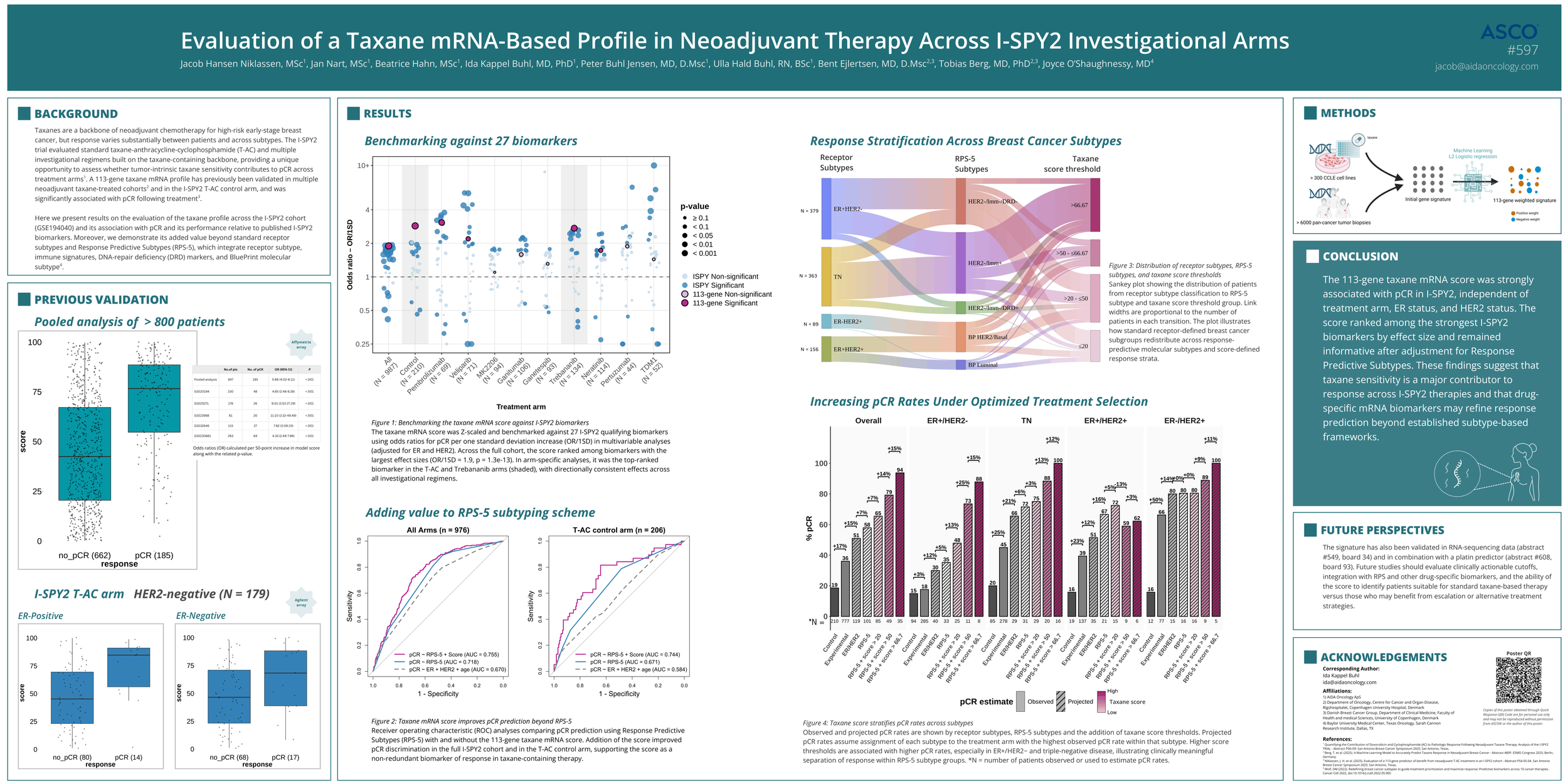
Agilent gene expression data from 987 high-risk eBC pre-treatment tumors (GSE194040) were analyzed from pts treated with T-AC ± nine IRs. Pts were scored on a scale from 0-100 and association of score (per 50-point increase) with pCR was assessed using logistic regression. For benchmarking, the raw score was Z-scaled, and OR was calculated per 1 standard deviation increase (OR/1SD) to enable comparison with published I-SPY2 biomarkers.
Results:
In a pooled multivariable logistic model including all treatment arms (N = 987), a 50-point increase in score was strongly associated with higher odds of pCR after adjusting for treatment arm, hormone receptor (HR) and HER2 (OR = 2.99, p = 7.93e-13). Allowing for treatment-specific score effects did not reveal statistically significant interactions.
The score was benchmarked against 27 I-SPY2 qualifying biomarkers using OR/1SD increase. In the full cohort (N = 987), it ranked among biomarkers with the largest effect sizes for pCR. When analyses were stratified by treatment arm, the score was the top-ranked biomarker by effect size in the T-AC arm (N = 210) and trebananib arm (N = 134), while effect estimates in other arms were directionally consistent but not uniformly statistically significant.
Furthermore, the score provided independent predictive information beyond I-SPY2 Response Predictive Subtypes (RPS). In multivariable models adjusting for RPS, the score remained significantly associated with pCR in the full cohort and the T-AC arm.
As an illustrative example, using score quartiles defined in the full cohort, pCR rates among HR+/HER2− pts (N = 379) increased from 6.0% (8/134) in the lower quartile to 43.1% (28/65) in the upper quartile. Similarly, among TN pts (N = 363), pCR rates increased from 16.7% (5/30) in the lower quartile to 48.7% (77/158) in the upper quartile.
Conclusions:
A taxane-specific gene expression score was strongly associated with pCR across all taxane-containing I-SPY2 regimens and provided information beyond established response predictive subtypes. These findings suggest that taxane sensitivity contributes substantially to treatment response across I-SPY2 therapies and highlights the potential value of incorporating additional drug-specific biomarkers to further refine response prediction.
Disclaimer:
This material on this page is ©2026 American Society of Clinical Oncology, all rights reserved. Licensing available upon request. For more information, please contact licensing@asco.org
Niklassen, J. H., Nart, J., Hahn, B., Buhl, I. K., Jensen, P. B., Buhl, U. H., Ejlertsen, B., Berg, T., O’Shaughnessy, J.
Contact:
Jacob Hansen Niklassen: jacob@aidaoncology.com