
Abstract
Prediction of pathologic response using a taxane-based gene expression signature in RNA-sequencing data from breast cancer patients receiving neoadjuvant therapy.
Background:
Taxanes are frequently used in both early and advanced breast cancer, but their use has not yet been guided by predictive biomarkers. We have previously validated a microarray-based 113-gene predictive signature for neoadjuvant taxane-based treatment across 6 independent cohorts, including I-SPY2. Here, we present our first validation of this signature in RNA-sequencing data.
Methods:
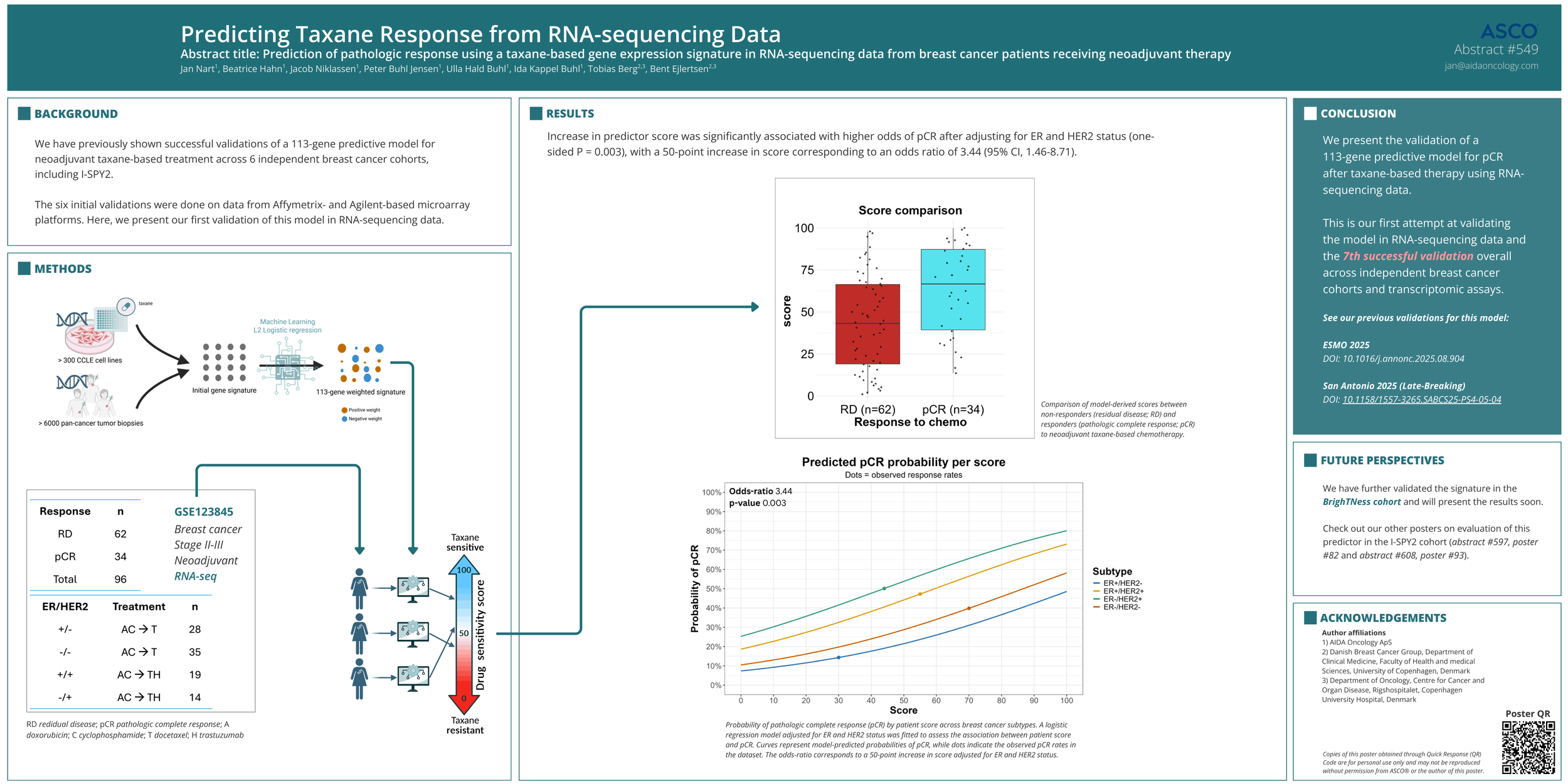
The study by Park et al. (2020; PMID: 33268821) enrolled 210 women with stage II–III invasive breast cancer, who received four cycles of neoadjuvant doxorubicin plus cyclophosphamide (AC) followed by four cycles of docetaxel (T) with trastuzumab (H) added for HER2-positive disease. We obtained pre-treatment TPM-normalized RNA-sequencing data from GEO (accession ID: GSE123845) for patients with available response data—pathologic complete response (pCR; n = 34) vs. residual disease (RD; n = 62)—following treatment completion (n = 96). To ensure compatibility between the RNA-sequencing data and microarray-based model, we performed frozen quantile normalization using the original training dataset for the model (GSE140494) as reference. We applied the signature on the normalized data to generate a response score for each patient in the range of 0-100 and evaluated the association between treatment response and patient score using logistic regression.
Results:
Increase in patient score was significantly associated with higher odds of pCR after adjusting for ER and HER2 status (one-sided P = 0.003), with a 50-point increase corresponding to an odds ratio of 3.44 (95% CI, 1.46-8.71), and an AUC of 0.74 for predicting pCR. Stratifying patients by median score revealed notable differences in pCR rates between low- and high-scoring patients. For ER+/HER2- patients (n = 28; median score = 26.6), the difference in pCR rates was 29% (0% vs. 29%) for patients below vs. above the median. Corresponding differences for triple-negative (n = 35; median score = 65.6) and HER2-positive patients (n = 33; median score = 51) were 13.8% (33.3% vs. 47.1%) and 39.4% (29.4% vs. 68.8%), respectively.
Conclusions:
We present the validation of a 113-gene predictive signature in RNA-sequencing data for achieving a pCR after taxane-based therapy. This is our first attempt at validating the signature in RNA-sequencing data, and the 7th successful validation overall across independent breast cancer cohorts. This result further highlights the signature’s potential as a tool to support taxane-based treatment guidance.
Disclaimer:
This material on this page is ©2026 American Society of Clinical Oncology, all rights reserved. Licensing available upon request. For more information, please contact licensing@asco.org
All authors and affiliations
Nart, J., Hahn, B., Niklassen, J. H., Jensen, P. B., Buhl, U. H., Buhl, I. K., Berg, T., Ejlertsen, B.
Contact:
Jan Nart: jan@aidaoncology.com