
Abstract
Background:
Carboplatin is part of NCCN-preferred neoadjuvant chemotherapy (NAC) for stage II-III triple negative (TN) early-stage breast cancer (eBC) as addition to taxane-containing standard-of-care, and significantly improves pathologic complete response (pCR) rates in multiple trials. In hormone receptor (HR)+/HER2− disease, platinum addition has been explored in investigational settings but is not standard.
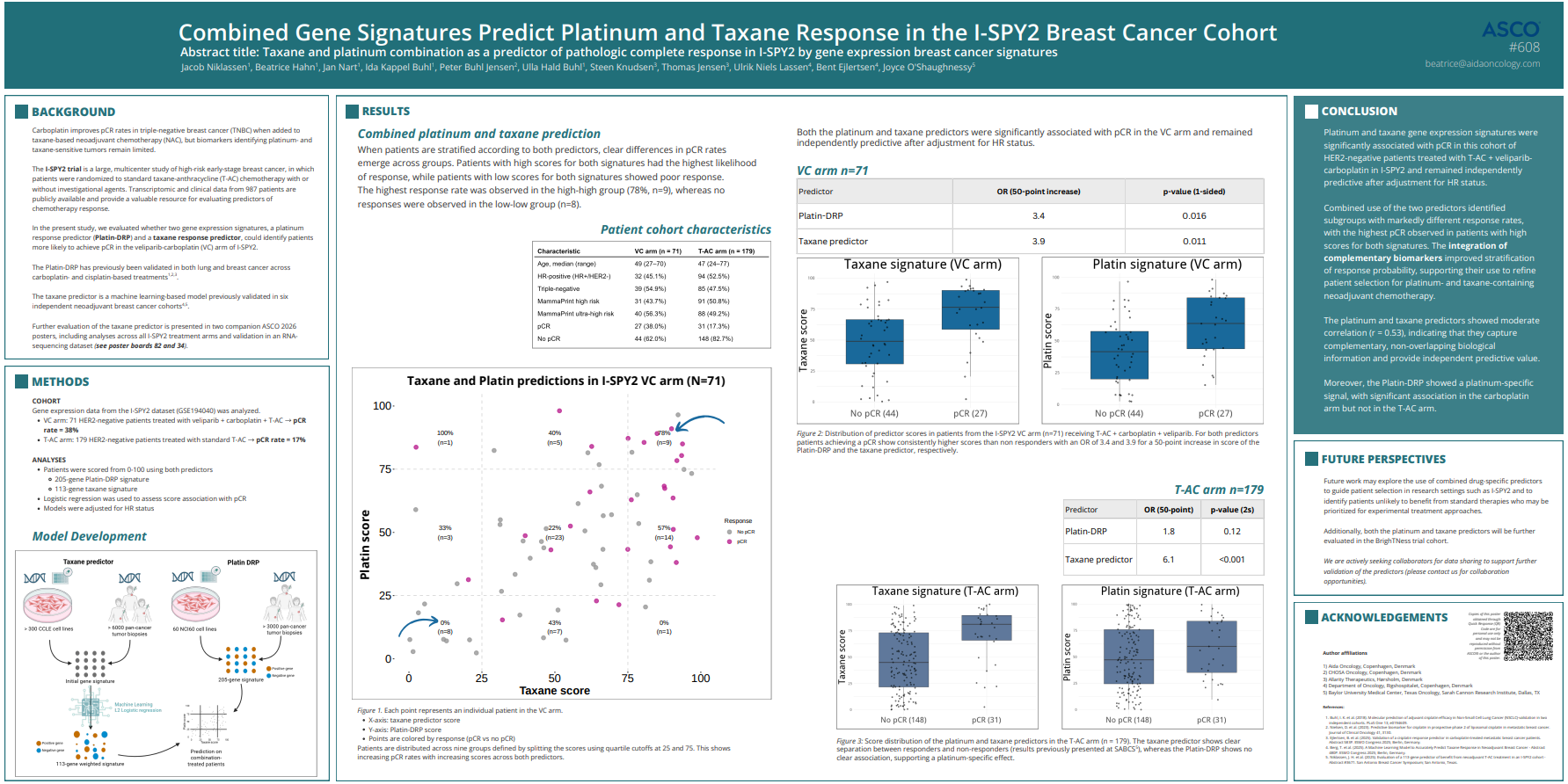
In I-SPY2 (NCT01042379), high-risk eBC pts were randomized to standard taxane-anthracycline (T-AC) with or without investigational agents. One arm evaluated carboplatin plus the PARP inhibitor veliparib added to T-AC (VC arm; 32 HR+/HER2- and 39 TN pts, n = 71).
Two gene signatures, a 205-gene Platin Drug Response Predictor (Platin-DRP) and a 113-gene taxane response predictor, have been validated for association with response to platinum agents and taxane-based regimens, respectively. This study evaluated their combined association with pCR in the I-SPY2 VC arm and their potential to inform platinum benefit in taxane-based NAC.
Methods:
Agilent gene expression data (GSE194040) from 987 high-risk eBC tumors were analyzed, focusing on 71 VC-arm pts and 179 HER2- T-AC pts. Samples were scored using each gene signature on a percentile scale (0–100). Associations between a 50-point increase in score and pCR were assessed using logistic regression with one-sided tests and 90% confidence interval (CI) lower bound (LB), unless otherwise specified.
Results:
The pCR rate in the VC arm was 38% (27/71), compared with 17.3% (31/179) in the control arm. In the VC arm, both the Platin-DRP (OR = 3.4, p = 0.016, 90% CI LB = 1.36) and the taxane predictor (OR = 3.88, p = 0.01, 90% CI LB = 1.54) were associated with pCR after adjustment for HR status and retained independent predictive value after adjustment for MammaPrint risk.
The platinum and taxane scores were moderately correlated (r = 0.53). In a bivariable model, inclusion of the Platin-DRP trended toward improved fit beyond the taxane score alone (two-sided (2s) p = 0.082). Dichotomization at 50 showed highest pCR in double-high pts (55%, 16/29), intermediate rates in discordant pts (33%, 7/21), and lowest rates in double-low pts (19%, 4/21). Quartile stratification further separated outcomes, with 78% pCR (7/9) in the high-high quartile and 0% (0/8) in the low-low quartile.The taxane score showed no evidence of arm-specific effects (control vs VC; 2s p = 0.97), whereas the Platin-DRP showed directionally stronger associations in the VC arm (2s p = 0.12).
Conclusions:
Taxane and platinum gene expression signatures showed complementary associations with pCR in the I-SPY2 veliparib-carboplatin arm. Joint modeling and stratification identified subgroups with distinct responses, supporting the potential utility of combining drug-specific biomarkers to refine patient selection for platinum addition in taxane-based NAC.
Authors and affiliations:
Jakob Niklassen (presenting author): J, Niklassen(1), Jan Nart: Nart, J. (1), Beatrice Hahn: Hahn, B. (1), Bent Ejlertsen: Ejlertsen, B. (3, 4), Ulla Hald Buhl: Buhl, U.H. (1) , Ida Kappel Buhl: Buhl, I.K. (1), Peter Buhl Jensen: Jensen, P.B. (1), Steen Knudsen: Knudsen, S. (5), Thomas Jensen: Jensen, T. (5), Ulrik Niels Lassen: Lassen, U.N. (6)
1: Aida Oncology ApS, Denmark
2: Paediatric Oncology Research Laboratory, Rigshospitalet, Denmark
3: Department of Oncology, Rigshospitalet, Denmark
4: Danish Breast Cancer Group, Rigshospitalet, Denmark
5: Allarity Therapeutics, Denmark
6: Rigshospitalet, Denmark
Contact:
Jacob Hansen Niklassen: jacob@aidaoncology.com